Key point
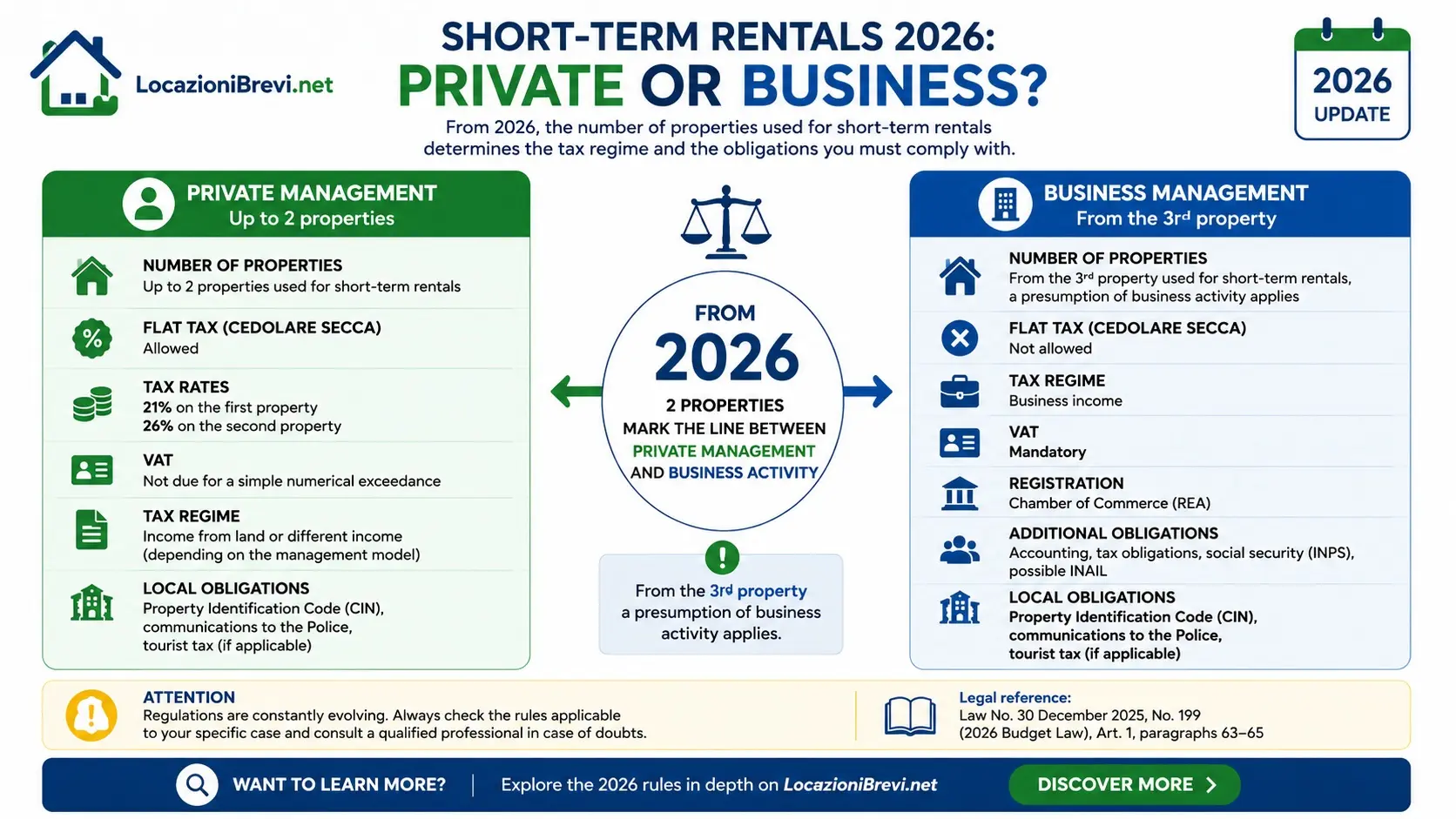
From the 2026 tax year, the special Italian tax regime for short-term rentals carried out outside a business applies where no more than two apartments are used for short-term rental during the tax year.
The taxpayer may apply the 21% Cedolare Secca rate to one chosen property and the 26% rate to the second qualifying property. Where three or more apartments are used, the activity is legally presumed to be carried on as a business.
1. What this guide covers
This guide concerns Italian income tax on rent and other consideration earned from qualifying short-term rental contracts.
It should not be confused with:
- municipal tourist tax collected from guests;
- IMU and other property-related municipal taxes;
- VAT and business taxation where the activity is entrepreneurial;
- Police guest registration through Alloggiati Web;
- regional statistical reporting and CIN obligations.
Separate obligations may apply to the same stay
Paying income tax does not satisfy tourist-tax, public-security, administrative or statistical duties.
2. What is a short-term rental for tax purposes?
The Italian short-term rental tax rules generally apply to residential rental contracts lasting no more than 30 days, entered into by individuals acting outside a business activity. The regime may also cover contracts that include linen, cleaning and closely connected services.
It may apply where the contract is concluded directly or through a property manager, estate agent or online booking platform.
Tourist rentals and tax-defined short-term rentals are not always identical
A contract may be a tourist rental under civil or regional rules without falling within every element of the special short-term rental tax regime. Duration, parties and services must be assessed.
3. When is the Cedolare Secca available?
The Cedolare Secca regime may be selected for a qualifying short-term rental when all the following conditions are met.
- Each rental agreement lasts no more than 30 days.
- No mandatory contract template is required. A written agreement is nevertheless strongly recommended.
- The rental concerns a residential property located in Italy, including related appurtenances rented with it. Eligible cadastral categories are A/1 to A/11, excluding A/10.
- The agreement may include limited ancillary services, such as bed linen, cleaning, Wi-Fi and the use of utilities or telephone services, provided that hotel-type services are not supplied.
- Both landlord and tenant are individuals entering into the agreement outside a business activity.
- The rules may also cover subleases, paid agreements concluded by a borrower under a comodato, and rentals of individual rooms, provided that each agreement does not exceed 30 days.
- The contract may be concluded directly or through an intermediary, including a real estate agent, property manager or online booking platform.
Eligibility must be checked case by case
Meeting these conditions means that Cedolare Secca may be available. The final tax treatment still depends on the taxpayer's circumstances, the nature of the services supplied and whether the activity is carried on as a business.
4. Private or business activity?
Cedolare Secca is available only to individuals acting outside a business activity. The classification depends both on the number of apartments and on the actual organisation and services used to operate the rentals.
| Situation from 2026 | General treatment |
|---|---|
| One apartment used for short-term rental | Non-business treatment may apply, subject to the facts of the activity |
| Two apartments used for short-term rental | Non-business treatment may still apply, subject to the facts |
| Three or more apartments used for short-term rental | Legal presumption that the activity is carried on as a business |
The two-property threshold is counted for each tax year and refers to apartments allocated to short-term rental, not merely to the number of bookings received.
5. What is Cedolare Secca?
Cedolare Secca is an optional substitute tax available to eligible individual landlords. It replaces ordinary personal income tax and the related regional and municipal surcharges on qualifying rental income.
For qualifying short-term contracts that do not require registration, the election is generally made directly in the Italian income tax return rather than through a separate advance filing.
The election is made in the tax return
The taxpayer selects the Cedolare Secca treatment and identifies the property benefiting from the 21% rate when completing the Italian income tax return.
6. The 21% and 26% rates
| Property | Cedolare Secca rate | Selection |
|---|---|---|
| One property chosen by the taxpayer | 21% | Identified in the annual Italian tax return |
| Second qualifying property | 26% | The higher rate applies to the other property |
The 21% rate does not necessarily have to be assigned to the first property purchased, first advertised or first rented. The taxpayer identifies the unit to which the reduced rate applies in the tax return.
The 21% rate does not apply to every apartment
Where two apartments generate qualifying short-term rental income, only one may benefit from 21%. The second is generally taxed at 26% if Cedolare Secca is chosen.
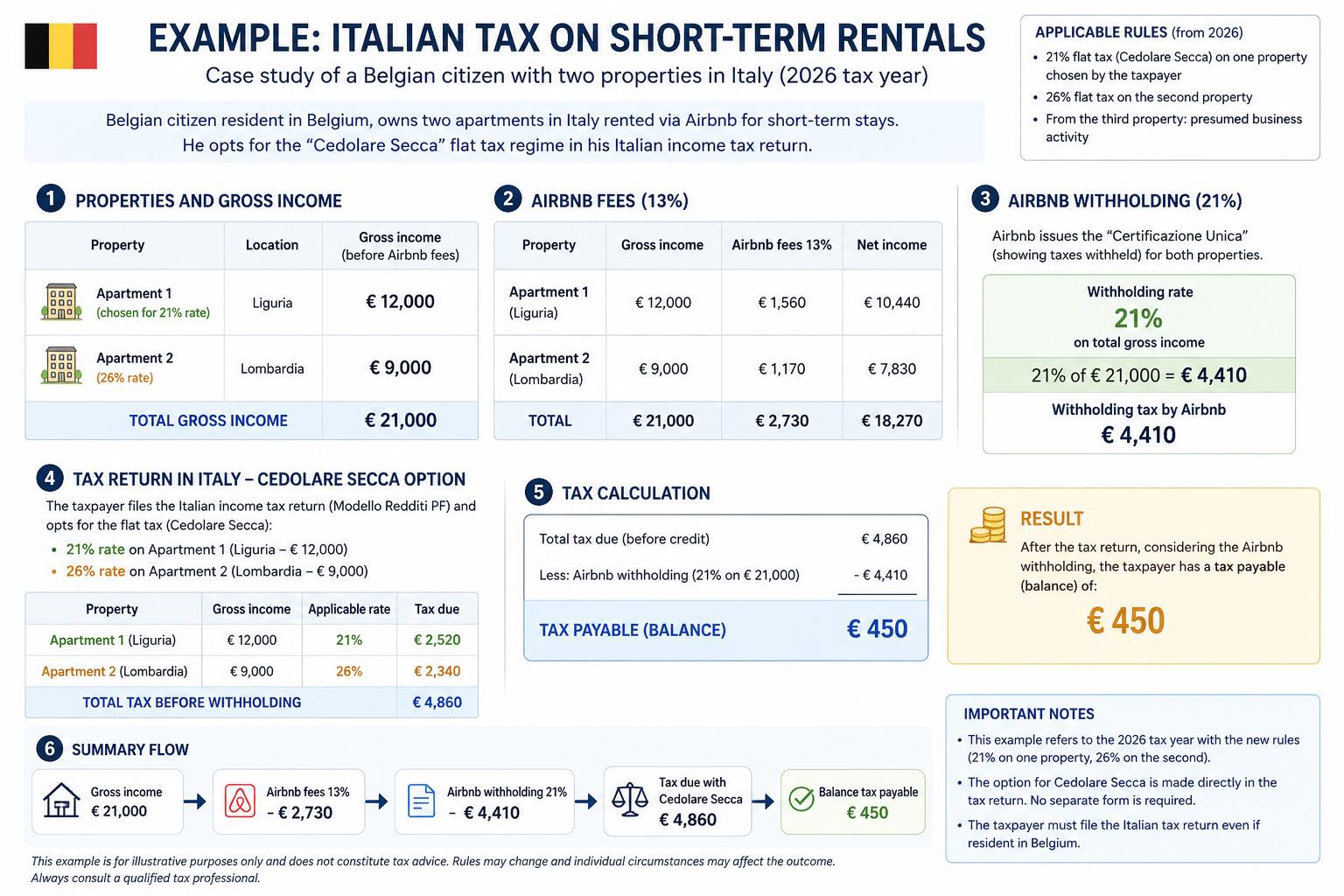
Italian tax calculation for a Belgian property owner
This infographic shows the application of the Cedolare Secca regime to a Belgian resident who owns two apartments in Italy and rents them through Airbnb.
Airbnb fees do not reduce the Cedolare Secca taxable amount
In this example, the 13% Airbnb fees affect the amount received by the owner, but the Cedolare Secca calculation is based on the gross rental income of €21,000. The example does not include any advance tax payments that may become due.
7. From the third property: presumed business activity
Article 1, paragraph 17, of Law no. 199 of 30 December 2025 reduced the threshold previously established by Law no. 178/2020 from four apartments to two.
Therefore, from 2026, using more than two apartments for short-term rental during the same tax year gives rise to a legal presumption that the activity is exercised as a business under Article 2082 of the Italian Civil Code.
Three apartments change the tax framework
From the third apartment, the private short-term rental regime and Cedolare Secca are generally no longer available. Business registration, VAT, accounting, social-security and administrative obligations may arise.
The threshold rule does not mean that operating one or two properties can never constitute a business. An organised activity, substantial additional services or other factual elements may still support business classification even below the statutory threshold.
8. Ordinary personal income taxation
An eligible private landlord may choose ordinary Italian personal income taxation instead of Cedolare Secca. Under ordinary taxation, the taxable rental income contributes to the taxpayer's overall income and is subject to the applicable IRPEF rates and surcharges.
The better option depends on the owner's total taxable income, available deductions, foreign tax position and the characteristics of the rental.
Cedolare Secca is optional
The existence of a 21% or 26% rate does not force the taxpayer to use it. Ordinary taxation remains an alternative where legally available.
9. Withholding by platforms and intermediaries
Intermediaries that receive or intervene in the payment of short-term rental consideration may be required to apply a 21% withholding tax and issue the relevant annual certification.
The withholding does not automatically settle every tax liability. Its treatment depends on whether the landlord ultimately chooses Cedolare Secca or ordinary taxation.
- Check the annual certification issued by each intermediary.
- Reconcile gross rent, platform fees and tax withheld.
- Include all qualifying income in the Italian return.
- Claim the withholding in the correct section of the return.
Platform withholding is not a substitute for filing
Even when Airbnb, a property manager or another intermediary withholds tax, the owner may still have to submit an Italian income tax return.
10. Filing the Italian income tax return
Italian rental income must be reported in the appropriate Italian income tax return. The return is generally transmitted electronically by 31 October of the following year. Where that date falls on a weekend or public holiday, the deadline moves to the next working day.
Example
Income earned during the 2026 tax year is reported in the Italian return filed in 2027. The exact 2027 filing calendar should be checked when the relevant forms and instructions are published.
Information normally required
- Italian tax code and taxpayer details;
- property identification and cadastral data;
- ownership percentage and holding period;
- gross short-term rental income for each property;
- days for which the property was rented;
- intermediary certifications and withholding tax;
- selection of Cedolare Secca or ordinary taxation;
- identification of the property receiving the 21% rate.
Tax return and tax payments have different deadlines
Income-tax balances and advance payments are usually due before the final filing deadline. Do not wait until October to calculate the amount payable.
11. Foreign property owners
Income from real estate situated in Italy is generally taxable in Italy even when the owner lives abroad. A non-resident owner may therefore need an Italian tax code, an Italian income tax return and Italian tax payments.
The same income may also need to be reported in the owner's country of tax residence. The applicable double-taxation treaty and domestic foreign-tax-credit rules determine how double taxation is relieved.
Italian tax does not automatically complete the foreign return
Keep the Italian return, payment receipts and intermediary certifications for use in the country of residence. Obtain advice that considers both jurisdictions.
12. Records, calculations and tax payments
Maintain a separate annual schedule for each apartment. The schedule should reconcile bookings, rental periods, gross consideration, platform statements, cancellations and withholding.
- rental contracts and booking confirmations;
- arrival and departure dates;
- gross rent before platform commissions;
- cleaning and other amounts charged to guests;
- platform and property-manager statements;
- Certificazioni Uniche issued by intermediaries;
- tax-return working papers and filing receipt;
- F24 payment receipts for balances and advance tax.
The basis for Cedolare Secca is not normally reduced by ordinary management costs or platform commissions. Calculations should be based on the gross taxable consideration under the applicable rules.
13. Common mistakes
- Applying the 21% rate to both apartments.
- Assuming platform withholding removes the filing obligation.
- Reporting net income after deducting platform commissions.
- Confusing tourist tax with the owner's income tax.
- Ignoring the new two-apartment limit from 2026.
- Waiting until October before calculating payments and advance tax.
- Failing to report Italian rental income in the country of residence.
- Treating an organised accommodation business as a private rental.
14. Frequently asked questions
What is the Cedolare Secca rate for one short-term rental property?
An eligible taxpayer may apply the 21% rate to one property chosen in the Italian income tax return.
How is the second apartment taxed?
If the conditions for the private short-term rental regime are met and Cedolare Secca is chosen, the second property is generally subject to the 26% rate.
What happens if I rent three apartments in 2026?
The activity is legally presumed to be carried on as a business because more than two apartments are allocated to short-term rental during the tax year.
Can one or two apartments still be treated as a business?
Yes. The threshold creates a presumption above two apartments, but the actual organisation and services may support business classification even below it.
Can I choose which apartment receives the 21% rate?
Yes. The taxpayer identifies the chosen property in the annual Italian income tax return.
Do I submit a separate Cedolare Secca application?
For qualifying short-term contracts that are not registered, the option is generally exercised directly in the income tax return.
Does Airbnb pay all my Italian tax?
No. A platform may apply withholding, but the owner must reconcile the income and determine the final liability in the Italian tax return.
Do foreign owners need to file in Italy?
Often yes. Income from Italian real estate is generally taxable in Italy even when the owner is non-resident.
Is the tax return always due exactly on 31 October?
That is the ordinary electronic filing deadline, but the date may move to the next working day or be changed by legislation. Check the official calendar for the relevant year.
Can I deduct Airbnb commissions under Cedolare Secca?
Ordinary platform commissions and management expenses do not generally reduce the gross taxable amount subject to Cedolare Secca.
15. Official sources
Tax forms, filing dates and Revenue Agency guidance may change. Check the rules and instructions applicable to the relevant tax year before preparing the return.
Need help with Italian rental taxation?
Studio Polli assists Italian and foreign owners with Cedolare Secca, tax returns, platform withholding and the transition to business activity.