Who is this guide for?
Private individuals who own, co-own, sublet or hold the use of residential property in Italy, including owners who live abroad and manage the accommodation directly or through an online platform.
A practical starting point for foreign and non-resident owners who want to rent an apartment, villa or holiday home in Italy in compliance with national, regional and municipal rules.
Italian short-term rentals are governed by a combination of national law, regional legislation, municipal rules and tax provisions. This English section helps you identify the right steps before publishing an advert or welcoming guests.
If you are a foreign or non-resident property owner planning to rent out an apartment, villa or holiday home in Italy, start by checking the short-term rental regulations that apply to your property. Our English guides explain CIN registration, opening requirements, police guest reporting, tourist tax and Italian rental income taxation. Requirements depend on the Region, municipality and how the rental activity is organised.
Private individuals who own, co-own, sublet or hold the use of residential property in Italy, including owners who live abroad and manage the accommodation directly or through an online platform.
An Italian short-term rental is generally a residential lease of no more than 30 consecutive days per guest. It is subject to specific civil, administrative, public-security and tax requirements.
Each guide explains one stage of the compliance process in plain English.
What the National Identification Code is, who needs it, how the BDSR works and where the code must be displayed.
Read the CIN guide →Learn when portable fire extinguishers, gas detectors and carbon monoxide detectors are required for tourist and short-term rentals in Italy, together with installation, maintenance and penalties.
Read the safety guide →Regional or municipal filings, property information, safety requirements and the steps to complete before advertising.
Read the opening requirements →How Alloggiati Web works, when guest details must be submitted and how to request access from the competent police authority.
Read the Police registration guide →When a municipality applies the tax, who pays it, exemptions, collection procedures and periodic reporting.
Read the tourist-tax guide →Ordinary income taxation, the flat-tax regime, platform withholding and issues affecting non-resident owners.
Read the taxation guide →Why a written agreement is advisable, what it should contain and when registration becomes relevant.
Read the contracts guide →Regional reporting systems, arrivals and overnight stays, reporting frequency and the distinction from police reporting.
Coming soonDefinitions, procedures and limits differ across Italy. Start from the Region where the property is located.
Coming soonReview the principal national, local, tax and reporting deadlines affecting short-term rentals.
View the deadlines calendar →The precise sequence varies locally, but most private owners will encounter these stages.
Identify the applicable regional category, municipal procedure and any condominium or contractual restrictions.
Submit the required regional or municipal communication and obtain any local identification code.
Use the BDSR platform and include the code in listings and other required communications.
Arrange Alloggiati Web access, tourism-statistics reporting and tourist-tax registration where applicable.
Coordinate the advert, house rules, price, contract, privacy information and mandatory identifiers.
Send guest information within the prescribed deadline and submit statistical data through the relevant regional system.
Collect it when due, apply exemptions correctly and file the municipal returns or payments required locally.
Reconcile rent, platform documentation and withholding, then apply the appropriate Italian tax treatment.
The rules may change when several properties, organised services, intermediaries or cross-border tax matters are involved.
Typical points to assess include:
Additional questions commonly include:
Italy has 20 Regions and two autonomous Provinces. Definitions, preliminary filings, statistics platforms and local identifiers can differ significantly.
Managing a holiday property in Italy from abroad involves more than collecting bookings. Non-resident owners may need to file an Italian income tax return, reconcile platform withholding and assess the applicable tax regime.
In principle, foreign ownership does not prevent the property from being rented. The owner must nevertheless comply with Italian property, tourism, public-security and tax rules, as well as any obligations in the country of tax residence.
The national identification system also covers residential units used for tourist or short-term rentals. The exact procedure depends on the property being correctly recorded in the relevant regional or provincial database.
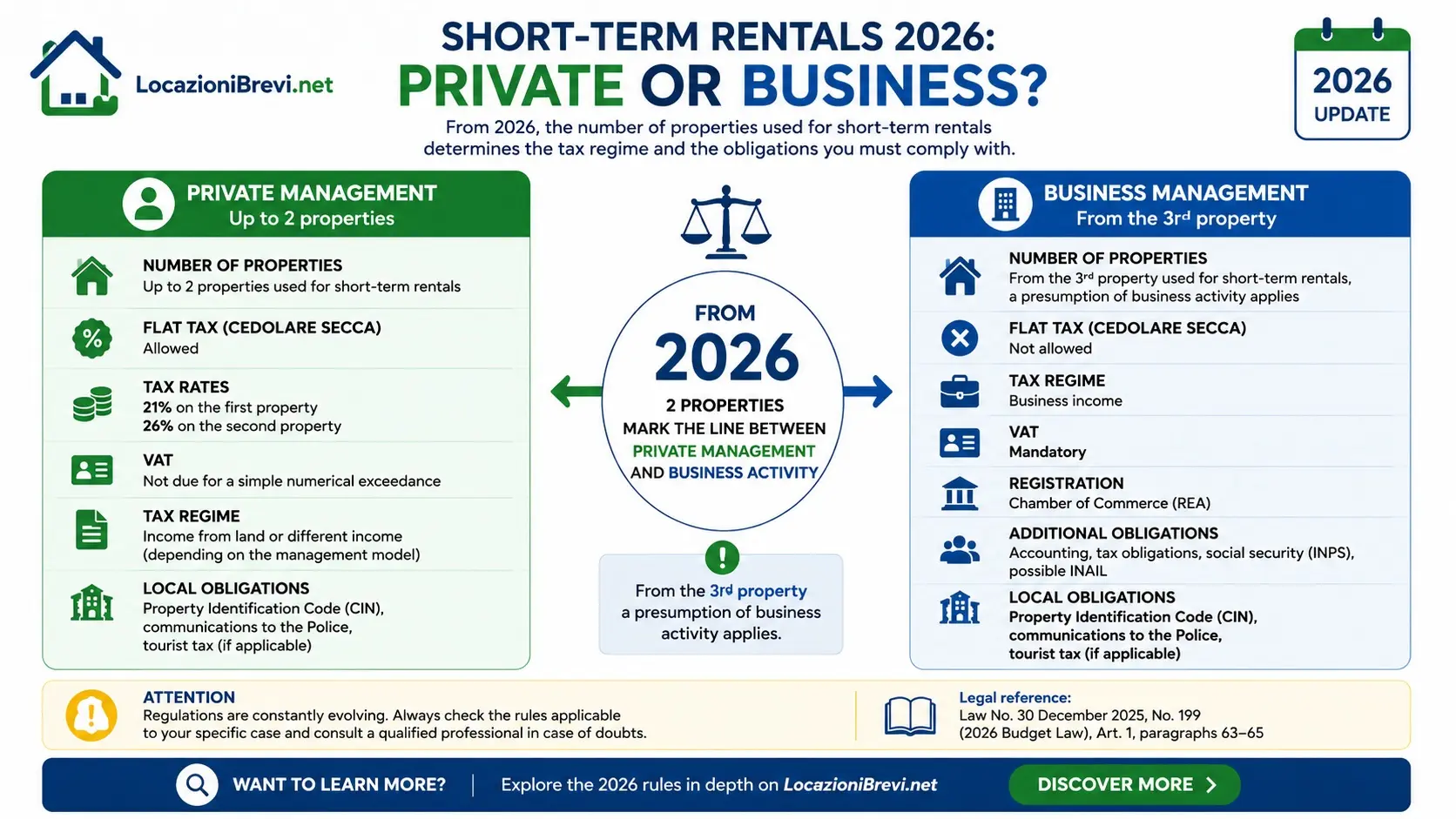
Not every private rental requires a VAT number. The answer depends on the number of properties, the continuity and organisation of the activity, the services offered and the applicable legal rules.
No. Tourist tax is municipal. Rates, age exemptions, maximum taxable nights, filing systems and payment deadlines are determined locally.
According to the Italian Revenue Agency, a short-term rental is generally not considered a business activity simply because it is advertised through online platforms. The key factor is whether the activity is carried out with an organised business structure. Providing services beyond the mere rental of the property—such as breakfast, meals, car rental, tourist guides, interpreters or similar hospitality services—may lead to the activity being treated as a business under Italian tax law.
No. A platform may collect payments, apply withholding or handle tourist tax in some municipalities, but the owner or manager can remain responsible for guest reporting, statistics, contracts, identifiers and tax-return reconciliation.