
Key point
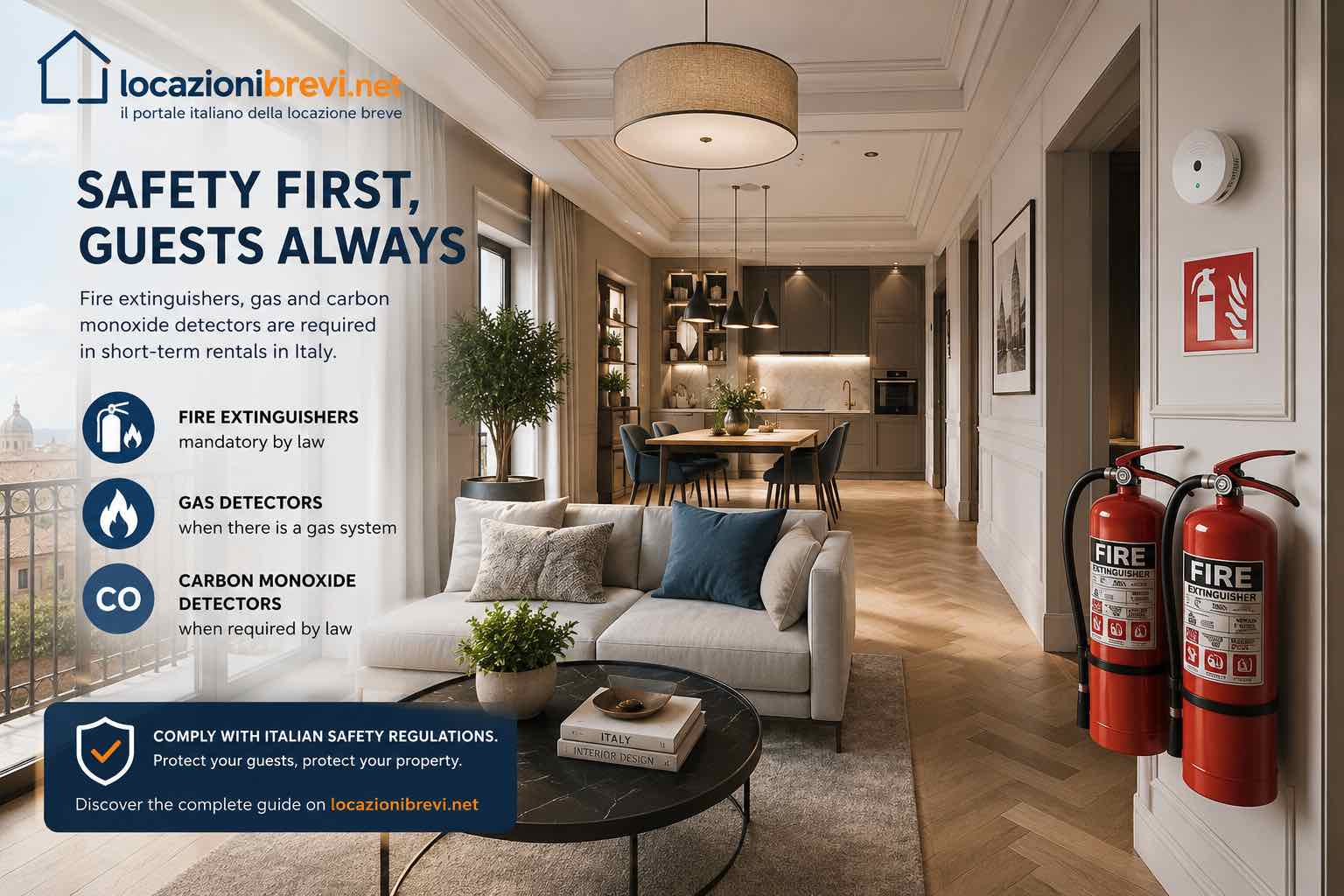
Italian national law requires residential units used for short-term rentals or tourist rentals to be equipped with compliant portable fire extinguishers. The rule applies to both business and non-business operators.
The obligation concerns each individual rented unit and is separate from the CIN, municipal filings, regional registration and guest-reporting duties.
1. The key rule
Article 13-ter of Decree-Law No. 145/2023 introduced national safety requirements for residential properties offered under short-term or tourist-rental contracts. Each covered unit must have functioning combustible-gas and carbon-monoxide detectors, where required, together with portable fire extinguishers compliant with the applicable rules.
This is a national obligation
The requirement applies throughout Italy. Regional legislation may add further requirements, but it cannot be used to disregard the national safety rules.
2. Which rentals are covered?
The requirement generally applies to residential units or portions of units offered under short-term or tourist-rental contracts without hotel-type services.
| Situation | National extinguisher rule |
|---|---|
| One apartment rented privately | Applies |
| Business-operated tourist rental | Applies |
| Non-business tourist rental | Applies |
| One room or part of a property | Applies to the rented unit or portion |
| Several apartments in the same building | Each apartment needs its own devices |
| Hotel, B&B or guesthouse | Subject to its own accommodation and fire-safety rules rather than this specific rental provision |
3. Minimum extinguisher specifications
According to the Ministry of Tourism's BDSR guidance, the extinguisher must meet both of the following minimum requirements:
- minimum extinguishing capacity: 13A;
- minimum charge: 6 kg or 6 litres.
The device must be compliant with the applicable product and maintenance rules. A very small domestic aerosol extinguisher or an undersized device should not be treated as an automatic substitute for the required extinguisher.
Check the label before purchasing
The label should clearly show the extinguishing rating, charge, conformity information and manufacturer instructions. Where in doubt, use a qualified fire-safety supplier.
4. How many extinguishers are required?
The statutory rule requires:
- at least one extinguisher for every 200 m² of floor area, or fraction thereof;
- in every case, at least one extinguisher on each floor.
| Property layout | Minimum practical result |
|---|---|
| Single floor, under 200 m² | At least 1 extinguisher |
| Single floor, over 200 m² and up to 400 m² | At least 2 extinguishers |
| Two floors, total area under 200 m² | At least 1 extinguisher per floor |
| Three separate rental apartments | Each apartment must be assessed and equipped separately |
5. Where should the extinguisher be placed?
The extinguisher must be ready for immediate use and placed in a position that is both accessible and clearly visible. The law and Ministry guidance particularly refer to:
- areas close to the entrance or normal access route;
- areas near the main sources of fire risk, without placing the device where the hazard could make it unreachable;
- a position that is not hidden inside a locked cupboard or blocked by furniture;
- a stable wall bracket or suitable support.
Current fire-prevention guidance cited by the Ministry indicates that the handle of a manual extinguisher should generally be positioned at approximately 110 cm above floor level.
Do not place it directly over the hob
An extinguisher must remain reachable if a fire starts. A position too close to the likely source of fire may make the device inaccessible precisely when it is needed.
6. Inspection and maintenance
Installing an extinguisher is not the end of the obligation. It must remain efficient and usable. Maintenance is governed by recognised technical practice, including the UNI 9994 framework and the manufacturer's instructions.
The owner or operator should arrange and document the applicable activities, which can include:
- initial verification after purchase or installation;
- routine visual surveillance;
- periodic checks by a competent maintenance provider;
- scheduled overhaul and pressure testing when due;
- replacement after use, damage, loss of pressure or expiry of components.
Keep the maintenance record
Retain invoices, service tags and maintenance reports. They help demonstrate that the extinguisher was not merely present but was being kept in working condition.
7. Gas and carbon-monoxide detectors
Fire extinguishers are only one part of the national safety package. Covered rentals must also have functioning devices capable of detecting combustible gas and carbon monoxide.
The Ministry recognises an exemption from detector installation where the property has no gas system and it can be established with certainty that there is no risk of uncontrolled combustible-gas release or carbon-monoxide formation.
Gas and carbon monoxide are different hazards. A single device should be used for both only when the manufacturer's documentation expressly confirms that it detects both risks and is suitable for the installation conditions.
Follow the manufacturer's positioning instructions
Detector height and location depend on the type of gas, the appliance and the device. Do not assume that every detector should be mounted in the same place.
8. Individual rooms and multiple apartments
The Ministry's FAQ confirms that renting only one room does not automatically remove the safety obligation. Portions of residential units offered under qualifying short-term or tourist-rental contracts must also comply.
Likewise, extinguishers installed in the common areas of a condominium do not replace those required inside the rented apartment. Where several apartments are rented in the same building, each unit must have its own compliant safety devices.
9. Penalties
Operating a covered tourist or short-term rental without functioning detectors and compliant portable extinguishers can result in an administrative fine of €600 to €6,000 for each established violation.
Other breaches, including the absence or non-display of the CIN, business activity without the required SCIA, or violations of regional and municipal rules, may lead to separate penalties.
Safety declarations must be accurate
The CIN procedure includes declarations concerning the applicable safety requirements. False or inaccurate declarations may have consequences beyond the administrative fine for missing devices.
10. Practical checklist for owners
Identify the legal category
Confirm that the property is being offered as a short-term or tourist rental rather than as a regulated accommodation establishment.
Measure the floor area and count floors
Use both criteria to determine the minimum number of extinguishers.
Check the extinguisher rating
Verify at least 13A and a charge of at least 6 kg or 6 litres.
Select accessible positions
Place devices visibly, near access routes and relevant risk areas.
Assess gas and CO risks
Install suitable detectors unless the official exemption can be safely and clearly supported.
Arrange maintenance
Follow technical standards and the manufacturer's maintenance schedule.
Keep evidence
Retain purchase documents, specifications, photographs and maintenance records.
11. Frequently asked questions
Does a private owner renting one apartment need an extinguisher?
Yes. The rule covers both business and non-business short-term and tourist rentals.
Is one extinguisher enough for a two-floor apartment?
No. There must be at least one extinguisher on each floor, even where the total floor area is below 200 m².
Are condominium extinguishers sufficient?
No. Each rented apartment must have its own required devices.
Can I use a small car extinguisher?
Only a device meeting the required minimum rating and charge may be relied upon. Many small automotive extinguishers do not meet the 13A and 6 kg or 6 litre minimums.
Are smoke detectors required by Article 13-ter?
The provision expressly refers to combustible-gas detectors, carbon-monoxide detectors and portable extinguishers. Smoke detection may still be advisable or required under other rules applicable to the property.
Must the extinguisher be installed by a technician?
The national provision does not expressly require a specialised installation project for a portable extinguisher. The device must nevertheless be compliant, correctly positioned and maintained. Fixed detection systems may trigger separate installer and documentation requirements.
Does the rule apply when only one room is rented?
Yes. The Ministry confirms that portions of residential units can also fall within the safety requirements.
12. Official sources and further guidance
Ministry FAQs and technical guidance can be updated. Owners should verify the current rules and use qualified professionals where the property's layout, systems or risks create uncertainty.
Need help with your Italian property?
Studio Polli assists Italian and foreign owners with CIN procedures, rental compliance, contracts, safety obligations and tax matters.